


• Tehran strikes Qatari LNG plant, Saudi and Kuwaiti refineries
• Trump warns of ‘furious response’ if attacks on Qatar continue
• Rules out troop deployment, but officials say reinforcements under review
• Hegseth sets no timeline for war; White House to seek $200bn more from Congress
• Global energy markets shaken; Brent jumps to $119, gas prices up 35pc
• Riyadh asserts it reserves right to retaliate after refinery drone strike
• Netanyahu says Israel ‘acted alone’ in striking Iran gas field
• Claims Tehran no longer able to enrich uranium or build missiles
DOHA: As Washington rushed to arm its Gulf allies with a $16.46 billion military package, Iran issued its starkest warning yet, vowing “zero restraint” if its energy infrastructure is targeted again, pushing the Middle East closer to a regional war.
The developments came after Iranian attacks on the world’s largest LNG plant in Qatar and refineries in Saudi Arabia and Kuwait sent shock waves through energy markets on Thursday, with the United States stressing that there was no deadline to end the Middle East war.
Amid growing fears over the economic damage from the war, US President Donald Trump said there would be no repeat of Israel’s attack on Iran’s key South Pars gas field, but he warned of a furious US response if Tehran did not halt strikes on Qatar.
Israeli Prime Minister Benjamin Netanyahu later claimed that Israel had acted unilaterally in striking Iran’s massive South Pars gas field. “Israel acted alone against the Asaluyeh gas compound… President Trump asked us to hold off on future attacks, and we’re holding out,” he has said at a televised press conference.
He also claimed in a news conference that Iran no longer has the capacity to enrich uranium or make ballistic missiles after 20 days of US-Israeli air attacks, Reuters reported.
Oil markets have already been shaken by Iran’s blocking of the Strait of Hormuz.
But the international benchmark Brent surged 10 per cent to $119 a barrel before falling back to $112, while European gas prices rose 35pc, after Iranian missiles hit Qatar’s huge Ras Laffan liquefied natural gas complex in retaliation for the Israeli strike on South Pars on Wednesday.
Interestingly, US Treasury Secretary Scott Bessent said Washington could consider lifting sanctions on Iranian oil already in transit. Talking to Fox Business, he added that the US government could also release more oil from its strategic reserves to help ease price pressure.
Meanwhile, QatarEnergy said that the nighttime attack on Ras Laffan, a repeated target since the start of the war on Feb 28, caused “extensive damage”.
Its CEO told Reuters the Iranian attacks had knocked out a sixth of Qatar’s LNG export capacity, worth $20bn a year, and that repairs would take three to five years.
Qatari Prime Minister Sheikh Mohammed bin Abdulrahman Al Thani said the attack was “clear proof” that Iran was going past its vow to only target US interests in the Gulf. And attacks blamed on Iran spread. A drone crashed into the Samref refinery in Saudi Arabia’s Red Sea port of Yanbu, the Saudi defence ministry said. The government reserved the “right to take military actions” in response.
In Kuwait, drone attacks sparked fires at the Mina Abdullah and Mina Al-Ahmadi refineries, which have a combined capacity of 800,000 barrels per day. Blasts were also heard in Bahrain’s capital of Manama, according to AFP.
‘Successive punishment’
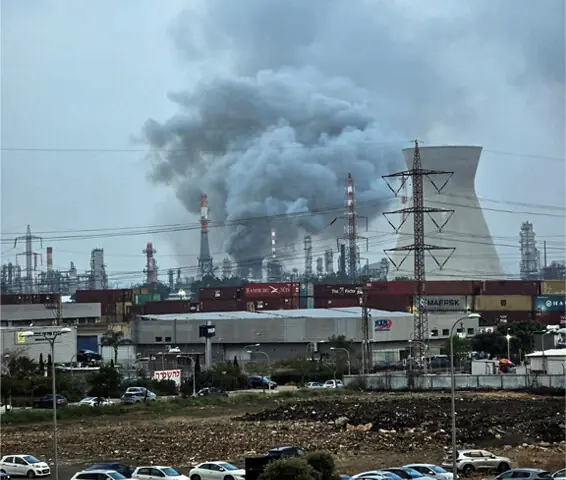
Even in Israel, the media said an oil refinery in the port of Haifa was hit on Thursday, after the military warned of missiles launched by Iran. Israel’s Kan 11 public broadcaster aired images on television showing a thick plume of dark smoke rising from the area of the refinery.
Iran’s semi-official Tasnim news agency also reported that Tehran had launched missiles at Israel, adding that Tel Aviv’s “successive punishment continues”.
The Israeli military said that its fighter jets had struck several Iranian naval vessels in the Caspian Sea the previous day, AFP reported. The targets included ships equipped with missile systems, support vessels and patrol craft, the military said, adding that a port command centre was also hit in the operation.
The targeted Iranian ships were also equipped with aerial surveillance systems and anti-submarine missiles, the military said.
Meanwhile, US and Israeli attacks in the morning in Iran’s north-western city of Tabriz killed several people, including four taekwondo athletes, Al Jazeera reported.
A US-based rights group reported more than 3,000 people killed in Iran by the US-Israeli strikes, a figure that could not be independently verified.
US F-35 damaged
Separately, a US F-35 fighter jet made an emergency landing at a US air base in the Middle East after it was struck by what is believed to be Iranian fire, CNN reported, citing two sources familiar with the matter. The strike would be the first time Iran has hit a US aircraft since the war began.
On the US military aid to the UAE and Kuwait, Secretary of State Marco Rubio has “determined and provided detailed justification that an emergency exists that requires the immediate sale” of the military equipment, thereby waiving the requirement that Congress give its approval.
The biggest single sale is of lower-tier air and missile defence sensor radars — which are designed to track high-speed targets and give data to a missile defence network — for $8bn, according to a statement from the State Department.
The next largest is to the United Arab Emirates for a long-range discrimination radar — which tracks ballistic missile threats — and related equipment at a cost of $4.5bn.
The UAE has also received approval to buy systems designed to defeat small, unmanned aircraft for $2.1bn, advanced air-to-air missiles for $1.22bn, and F-16 warplane munitions and upgrades for $644 million.
‘Zero restraint’
Trump indicated he did not know in advance about Israel’s raid on South Pars, which supplies about 70pc of Iran’s domestic needs. But he said he had told Israeli Prime Minister Benjamin Netanyahu not to hit more gas fields in Iran.
“We get along great. It’s coordinated, but on occasion, he’ll do something” that the United States opposes, Trump told reporters in the Oval Office, where he met Japanese Prime Minister Sanae Takaichi. “I told him, ‘Don’t do that’, and he won’t do that,” he said. He also said on Thursday that there was no current plan to send troops into Iran. At his meeting with Takaichi, Trump said he had no plans to deploy ground forces. “I’m not putting troops anywhere,” he said.
However, a US official and three other people familiar with the planning told Reuters that Trump was considering sending thousands more US troops to the Middle East.
Iran responded to the threats with defiance. The military’s Khatam Al-Anbiya operational command vowed the “complete destruction” of Gulf energy infrastructure if the Israeli attack was repeated, according to a statement carried by Fars news agency.
Foreign Minister Abbas Araghchi said on social media there would be “ZERO restraint” if Iran’s infrastructure was hit again.
There is growing concern among the world’s major economies over fallout from the conflict. Britain, France, Germany, Italy, Japan and the Netherlands said they would “contribute to appropriate efforts to ensure safe passage through the Strait of Hormuz” but gave few details.
French President Emmanuel Macron condemned the “reckless escalation” in attacks and called for “direct talks between the Americans and Iranians on this matter”.
UK Prime Minister Keir Starmer’s office warned that “attacks on critical infrastructure risked pushing the region further into crisis”, after talks with Macron and Nato chief Mark Rutte.
UN Secretary-General Antonio Guterres also urged restraint, warning that the conflict risked spiralling “out of control” with “potential tragic consequences” for civilians and the global economy.
Meanwhile, US Defence Secretary Pete Hegseth said there is no time frame for ending the war, but that “we’re very much on track” and Trump would choose when to end fighting.
Published in Dawn, March 20th, 2026
from Dawn - Home https://ift.tt/QiwNP3o
• Tehran strikes Qatari LNG plant, Saudi and Kuwaiti refineries
• Trump warns of ‘furious response’ if attacks on Qatar continue
• Rules out troop deployment, but officials say reinforcements under review
• Hegseth sets no timeline for war; White House to seek $200bn more from Congress
• Global energy markets shaken; Brent jumps to $119, gas prices up 35pc
• Riyadh asserts it reserves right to retaliate after refinery drone strike
• Netanyahu says Israel ‘acted alone’ in striking Iran gas field
• Claims Tehran no longer able to enrich uranium or build missiles
DOHA: As Washington rushed to arm its Gulf allies with a $16.46 billion military package, Iran issued its starkest warning yet, vowing “zero restraint” if its energy infrastructure is targeted again, pushing the Middle East closer to a regional war.
The developments came after Iranian attacks on the world’s largest LNG plant in Qatar and refineries in Saudi Arabia and Kuwait sent shock waves through energy markets on Thursday, with the United States stressing that there was no deadline to end the Middle East war.
Amid growing fears over the economic damage from the war, US President Donald Trump said there would be no repeat of Israel’s attack on Iran’s key South Pars gas field, but he warned of a furious US response if Tehran did not halt strikes on Qatar.
Israeli Prime Minister Benjamin Netanyahu later claimed that Israel had acted unilaterally in striking Iran’s massive South Pars gas field. “Israel acted alone against the Asaluyeh gas compound… President Trump asked us to hold off on future attacks, and we’re holding out,” he has said at a televised press conference.
He also claimed in a news conference that Iran no longer has the capacity to enrich uranium or make ballistic missiles after 20 days of US-Israeli air attacks, Reuters reported.
Oil markets have already been shaken by Iran’s blocking of the Strait of Hormuz.
But the international benchmark Brent surged 10 per cent to $119 a barrel before falling back to $112, while European gas prices rose 35pc, after Iranian missiles hit Qatar’s huge Ras Laffan liquefied natural gas complex in retaliation for the Israeli strike on South Pars on Wednesday.
Interestingly, US Treasury Secretary Scott Bessent said Washington could consider lifting sanctions on Iranian oil already in transit. Talking to Fox Business, he added that the US government could also release more oil from its strategic reserves to help ease price pressure.
Meanwhile, QatarEnergy said that the nighttime attack on Ras Laffan, a repeated target since the start of the war on Feb 28, caused “extensive damage”.
Its CEO told Reuters the Iranian attacks had knocked out a sixth of Qatar’s LNG export capacity, worth $20bn a year, and that repairs would take three to five years.
Qatari Prime Minister Sheikh Mohammed bin Abdulrahman Al Thani said the attack was “clear proof” that Iran was going past its vow to only target US interests in the Gulf. And attacks blamed on Iran spread. A drone crashed into the Samref refinery in Saudi Arabia’s Red Sea port of Yanbu, the Saudi defence ministry said. The government reserved the “right to take military actions” in response.
In Kuwait, drone attacks sparked fires at the Mina Abdullah and Mina Al-Ahmadi refineries, which have a combined capacity of 800,000 barrels per day. Blasts were also heard in Bahrain’s capital of Manama, according to AFP.
‘Successive punishment’
Even in Israel, the media said an oil refinery in the port of Haifa was hit on Thursday, after the military warned of missiles launched by Iran. Israel’s Kan 11 public broadcaster aired images on television showing a thick plume of dark smoke rising from the area of the refinery.
Iran’s semi-official Tasnim news agency also reported that Tehran had launched missiles at Israel, adding that Tel Aviv’s “successive punishment continues”.
The Israeli military said that its fighter jets had struck several Iranian naval vessels in the Caspian Sea the previous day, AFP reported. The targets included ships equipped with missile systems, support vessels and patrol craft, the military said, adding that a port command centre was also hit in the operation.
The targeted Iranian ships were also equipped with aerial surveillance systems and anti-submarine missiles, the military said.
Meanwhile, US and Israeli attacks in the morning in Iran’s north-western city of Tabriz killed several people, including four taekwondo athletes, Al Jazeera reported.
A US-based rights group reported more than 3,000 people killed in Iran by the US-Israeli strikes, a figure that could not be independently verified.
US F-35 damaged
Separately, a US F-35 fighter jet made an emergency landing at a US air base in the Middle East after it was struck by what is believed to be Iranian fire, CNN reported, citing two sources familiar with the matter. The strike would be the first time Iran has hit a US aircraft since the war began.
On the US military aid to the UAE and Kuwait, Secretary of State Marco Rubio has “determined and provided detailed justification that an emergency exists that requires the immediate sale” of the military equipment, thereby waiving the requirement that Congress give its approval.
The biggest single sale is of lower-tier air and missile defence sensor radars — which are designed to track high-speed targets and give data to a missile defence network — for $8bn, according to a statement from the State Department.
The next largest is to the United Arab Emirates for a long-range discrimination radar — which tracks ballistic missile threats — and related equipment at a cost of $4.5bn.
The UAE has also received approval to buy systems designed to defeat small, unmanned aircraft for $2.1bn, advanced air-to-air missiles for $1.22bn, and F-16 warplane munitions and upgrades for $644 million.
‘Zero restraint’
Trump indicated he did not know in advance about Israel’s raid on South Pars, which supplies about 70pc of Iran’s domestic needs. But he said he had told Israeli Prime Minister Benjamin Netanyahu not to hit more gas fields in Iran.
“We get along great. It’s coordinated, but on occasion, he’ll do something” that the United States opposes, Trump told reporters in the Oval Office, where he met Japanese Prime Minister Sanae Takaichi. “I told him, ‘Don’t do that’, and he won’t do that,” he said. He also said on Thursday that there was no current plan to send troops into Iran. At his meeting with Takaichi, Trump said he had no plans to deploy ground forces. “I’m not putting troops anywhere,” he said.
However, a US official and three other people familiar with the planning told Reuters that Trump was considering sending thousands more US troops to the Middle East.
Iran responded to the threats with defiance. The military’s Khatam Al-Anbiya operational command vowed the “complete destruction” of Gulf energy infrastructure if the Israeli attack was repeated, according to a statement carried by Fars news agency.
Foreign Minister Abbas Araghchi said on social media there would be “ZERO restraint” if Iran’s infrastructure was hit again.
There is growing concern among the world’s major economies over fallout from the conflict. Britain, France, Germany, Italy, Japan and the Netherlands said they would “contribute to appropriate efforts to ensure safe passage through the Strait of Hormuz” but gave few details.
French President Emmanuel Macron condemned the “reckless escalation” in attacks and called for “direct talks between the Americans and Iranians on this matter”.
UK Prime Minister Keir Starmer’s office warned that “attacks on critical infrastructure risked pushing the region further into crisis”, after talks with Macron and Nato chief Mark Rutte.
UN Secretary-General Antonio Guterres also urged restraint, warning that the conflict risked spiralling “out of control” with “potential tragic consequences” for civilians and the global economy.
Meanwhile, US Defence Secretary Pete Hegseth said there is no time frame for ending the war, but that “we’re very much on track” and Trump would choose when to end fighting.
Published in Dawn, March 20th, 2026


0 Comments