


• Passengers travelling abroad have complained of long queues stretching out of terminals, repeated questioning, delays in immigration at three main international airports
• Situation ‘has improved’ in recent weeks; officials insist there are ‘no unnecessary delays’, added scrutiny takes time
• Airport authority, FIA deflect blame for overcrowding onto other agencies
THE never-ending queue had already spilled beyond the glass doors when Jawad Ahmad Rizvi arrived at Lahore airport for his flight to Dubai. The line snaked past the entrance, with passengers clutching their passports and boarding passes, shifting their luggage inch by inch.
“On my arrival, I found the queue extending beyond the entrance of the main terminal, making me wonder how many people were travelling by air these days.
“As the queue was moving slowly, it took me about 20 minutes to put my luggage on the scanner belt, and an additional 15 minutes for the belt to clear,” he told Dawn.
The checks did not end there. Mr Rizvi said that after the luggage was cleared by the scanner, a security official checked his and other passengers’ passports a second time — the first check being conducted upon their entrance to the terminal.
“The official asked me, where are you going, for what purpose, what do you do, and how much cash do you have?”
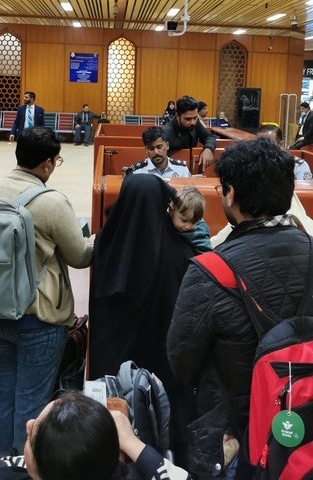
After obtaining a boarding pass, another “long queue at the passport control counter [awaited me], which was really tiresome. The authorities need to set up more counters to break the long queues.”
Over the past few months, passengers travelling abroad from Karachi, Lahore and Islamabad have increasingly complained of long queues, repeated questioning and prolonged immigration clearance.
The tightening of checks follows a wider crackdown on human smuggling in the wake of several boat tragedies involving illegal migrants, as well as complaints from Gulf countries about the number of beggars travelling there.
In response, authorities have stepped up scrutiny at airports, intensifying document verification and offloading hundreds of passengers who did not pass strict checks. According to the interior ministry, at least 51,000 passengers were offloaded at airports in 2025, mostly at Lahore and Karachi, over insufficient or unverified documentation.
Lahore: scrutiny and space constraints
At Lahore’s Allama Iqbal International Airport, at times, queues stretch outside the terminal buildings during peak departure hours.
The Federal Investigation Agency (FIA) has acknowledged that it has been carrying out stricter screening of passengers travelling to destinations including Saudi Arabia, Iran, Azerbaijan, the United Arab Emirates, Thailand, Malaysia, Qatar, Egypt and various European countries, in an effort to curb human smuggling and travel by beggars.
When Dr Amir Butt intended to travel from Lahore to Baku, he found himself caught in that net.
“To my surprise, I found unusually long queues at the immigration counter. Finally, when my turn came, the FIA official at the passport control counter asked me that since I was going to Baku for the fourth time in the last few years, was there any specific reason for that?
“I told him the trip to Baku does not cost me much. He then asked me to see another FIA official in a room next to the counter, where I was further quizzed about my profession and the purpose of my trip. After that cumbersome process, I was allowed to board the plane,” Dr Butt told Dawn.
“The FIA official [looks] at you as if he or she [has] seen a human for the first time, then looks at [the] passport, then stares at you, and looks at your passport again… This process continues for 3 to 4 mins… [while the government] is investing $1 billion in artificial intelligence!”
When approached, an FIA official defended the heightened scrutiny.
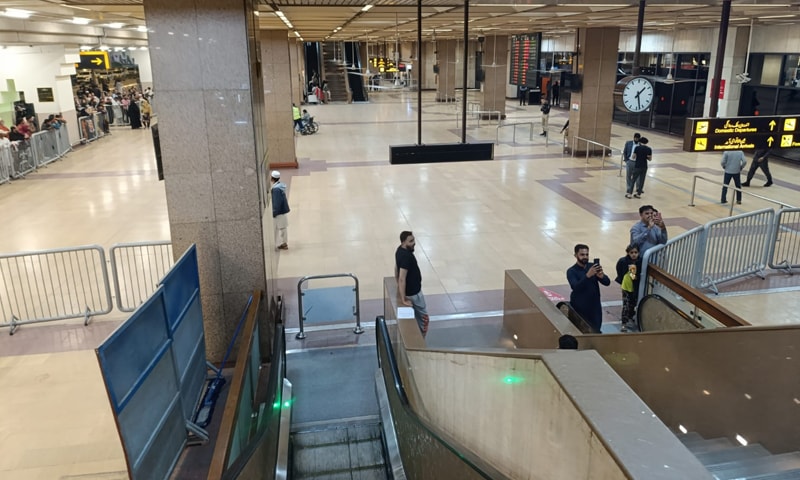
“Security checks, like those manned by the Airports Security Force (ASF) and Customs, as well as baggage checks, the check-in flight counter and passport control counter were already in place at the airports. But the long queues and delays at immigration counters have cropped up since the agency placed a strong security check to weed out potential illegal immigrants and beggars,” he said.
He added that there were clear instructions from the interior ministry that passengers with invalid, incomplete or bogus documents should not be allowed to travel abroad.
“Every FIA official at immigration gets more conscious of this fact and takes extra time in screening the passengers. There is a need for more counters with dedicated staff to avert long queues,” he said, pointing to a shortage of immigration personnel and limited space at Lahore airport.
Yet, FIA Lahore immigration head Avais Shafiq denied that there were long queues at immigration counters. “I haven’t seen any queues at immigration counters. They are outside the airport entrance where the ASF checks them,” he maintained.
In 2025, Lahore airport handled 6.86 million passengers. The sheer volume, coupled with tighter checks, has put visible strain on infrastructure.
Canadian national Navid Manzoor said travelling alone is manageable, but flying with family is another matter altogether.
“In the very first place, not finding the trolley (for luggage), kids getting upset with long queues and multiple checking points … as a whole … the system at the airport should be well organised like that of any developed country. The government can [do so] it has the will,” he said.
Karachi: from chaos to control?
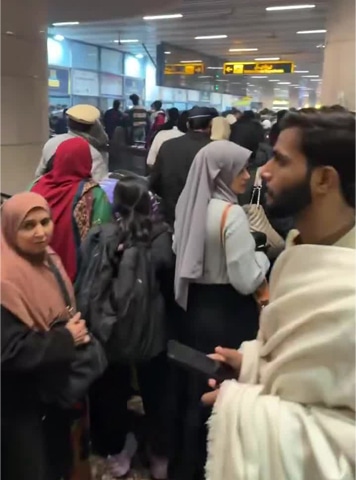
A few weeks ago, social media was flooded with images of overcrowding at Karachi’s Jinnah International Airport. Passengers described it as “a place of embarrassment for international travellers and a daily humiliation for Pakistani citizens, thanks to basic operational incompetence.”
The situation, however, has changed drastically over the past few days, and things have started to return to normal.
An official said the FIA’s strict measures contributed to delays, but insisted the agency’s role begins inside the passengers’ lounge.
“It is true that the FIA has taken certain measures, but their sole purpose is to strictly enforce the law and not to cause inconvenience to people,” he said.
“How can the agency be held responsible for overcrowding at entry points, the unavailability of trolleys or the long queues at the airport’s main entrance?”
Recently, the official said, all relevant authorities had come together and devised a joint strategy that helped bring the situation under control. “This achievement is the result of the collective efforts of the FIA, Pakistan Airports Authority, Airport Security Force and the airlines.”
Some travellers, however, still speak of difficulties at Jinnah International. Muaaz Ibrahim said his brother, who has been working in Saudi Arabia for four years, faced an unexpectedly long scrutiny.
“My brother’s documents were checked at the FIA counter for so long that he almost missed his flight. He said that nothing like this had ever happened before, and the experience took him by surprise,” Mr Ibrahim told Dawn.
The FIA says it has made 20 counters operational during midnight hours, when multiple international flights depart, and deployed a full-strength shift from 2am onwards.
“These measures have not only [helped] crack down on illegal travel, but also prevent wrongdoing within the agency itself,” an official said. “I can say with full confidence that these measures have greatly helped in eliminating organised corruption.”
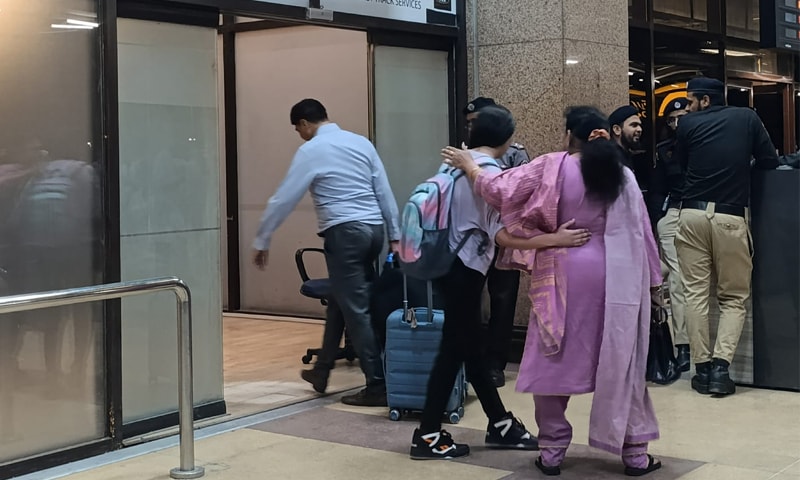
FIA Karachi Zone Director Muntazar Mehdi, during a recent surprise visit to the airport, expressed satisfaction with immigration operations and said ensuring security while respecting the dignity of passengers remains the agency’s top priority.
Islamabad: speed vs suspicion
Complaints about repeated questioning have not been limited to Lahore and Karachi alone. Passenger Khurram Zuberi recently posted about his experience at Islamabad International Airport.
He said his passport was first checked at the airport entrance, then again by Customs officials, followed by the Anti-Narcotics Force. He then navigated the airline counter, the immigration counter where he was quizzed by an FIA officer, then at the airline gate, and once more before he entered the tunnel leading to the plane.
“The FIA official [looks] at you as if he or she [has] seen a human for the first time, then looks at [the] passport, then stares at you, and looks at your passport again, then looks at your ticket, and looks at your passport again, then looks at you again, and looks at passport again. This process continues for 3-4 min, and all that continues where the [government] is investing $1billion in artificial intelligence!!,” he wrote on X, describing his experience.
Officials at the Islamabad airport, however, paint an altogether different picture.
FIA Islamabad Director Shahzad Nadeem Bukhari claimed that immigration clearance takes an average of one minute and 25 seconds, with 15 counters operational at departure and 14 at arrival.
A dedicated counter facilitates diplomats and Chinese nationals associated with the China-Pakistan Economic Corridor (CPEC) projects.
Officials argue that vigilant screening has reduced illegal travel attempts relative to overall passenger flow. Islamabad airport handled 7.87 million passengers in 2025, including 5.41 million international travellers.
In 2024, 6,435 people were offloaded at Islamabad airport; in 2025, the number rose to 7,115.
Responding to complaints that immigration officers ask questions already answered on boarding passes, the director said staff must ensure passengers know where they are going and for what purpose.
He cited cases in which individuals carried what appeared to be official letters from the Federal Board of Revenue (FBR) to attend a conference in Europe. When questioned, they failed to provide basic details and it later emerged that they had paid Rs2.3 million each to an agent.
Azmat Hussain, a Rawalpindi resident who recently travelled from Islamabad airport, described a smoother experience.
“As I walked towards the international departure lounge, a security official standing there asked me to show my ticket, and then asked me, ‘Where are you going?’. After I replied to him, I was allowed inside for another baggage scanning.”
He added: “Nobody asked me anything at the immigration counter, so I moved towards the waiting area to board the flight.”
When questioned about the layered approach, an official told Dawn that the process was like a “defence shield”.
“Airport security works … [has] multiple rings: outer ring — entry control, middle ring – initial screening, inner ring — final boarding security. More layers mean more safety,” he said.
“As someone deeply connected with ASF history and security culture, one should know that aviation security is about prevention, not reaction,” he added.
Between dignity and deterrence
The Pakistan Airports Authority (PAA) maintains that infrastructure at major airports is operating within defined capacity, and that immigration staffing falls under the FIA’s mandate.
The ASF says enhanced vigilance, including vehicle checks and additional personnel, may lengthen procedures but is necessary in light of recent security concerns.
Yet, public frustration persists, and it is not just limited to the common man; even Senator Sherry Rehman recently posted about her experience at Islamabad airport.
“What is happening at Pakistan’s airports? At Islamabad airport this morning, the second gate for women was routinely closed, while a long line of women stood waiting only on the one open gate. They opened the second gate earmarked for women when I insisted that these passengers, too, are entitled to public services,” she posted on X earlier this month, before boarding an international flight.
“Unfortunately, when I went back to check 10 minutes later, the gate was firmly closed again. It was opened yet again after I stood there and repeated the whole exercise, but now that I’ve boarded, I’m pretty sure it’s closed again. This is a fight I regularly have at Karachi airport too, but there is no change in behaviour.”
Published in Dawn, February 25th, 2026
from Dawn - Home https://ift.tt/4KC0WTV
• Passengers travelling abroad have complained of long queues stretching out of terminals, repeated questioning, delays in immigration at three main international airports
• Situation ‘has improved’ in recent weeks; officials insist there are ‘no unnecessary delays’, added scrutiny takes time
• Airport authority, FIA deflect blame for overcrowding onto other agencies
THE never-ending queue had already spilled beyond the glass doors when Jawad Ahmad Rizvi arrived at Lahore airport for his flight to Dubai. The line snaked past the entrance, with passengers clutching their passports and boarding passes, shifting their luggage inch by inch.
“On my arrival, I found the queue extending beyond the entrance of the main terminal, making me wonder how many people were travelling by air these days.
“As the queue was moving slowly, it took me about 20 minutes to put my luggage on the scanner belt, and an additional 15 minutes for the belt to clear,” he told Dawn.
The checks did not end there. Mr Rizvi said that after the luggage was cleared by the scanner, a security official checked his and other passengers’ passports a second time — the first check being conducted upon their entrance to the terminal.
“The official asked me, where are you going, for what purpose, what do you do, and how much cash do you have?”
After obtaining a boarding pass, another “long queue at the passport control counter [awaited me], which was really tiresome. The authorities need to set up more counters to break the long queues.”
Over the past few months, passengers travelling abroad from Karachi, Lahore and Islamabad have increasingly complained of long queues, repeated questioning and prolonged immigration clearance.
The tightening of checks follows a wider crackdown on human smuggling in the wake of several boat tragedies involving illegal migrants, as well as complaints from Gulf countries about the number of beggars travelling there.
In response, authorities have stepped up scrutiny at airports, intensifying document verification and offloading hundreds of passengers who did not pass strict checks. According to the interior ministry, at least 51,000 passengers were offloaded at airports in 2025, mostly at Lahore and Karachi, over insufficient or unverified documentation.
Lahore: scrutiny and space constraints
At Lahore’s Allama Iqbal International Airport, at times, queues stretch outside the terminal buildings during peak departure hours.
The Federal Investigation Agency (FIA) has acknowledged that it has been carrying out stricter screening of passengers travelling to destinations including Saudi Arabia, Iran, Azerbaijan, the United Arab Emirates, Thailand, Malaysia, Qatar, Egypt and various European countries, in an effort to curb human smuggling and travel by beggars.
When Dr Amir Butt intended to travel from Lahore to Baku, he found himself caught in that net.
“To my surprise, I found unusually long queues at the immigration counter. Finally, when my turn came, the FIA official at the passport control counter asked me that since I was going to Baku for the fourth time in the last few years, was there any specific reason for that?
“I told him the trip to Baku does not cost me much. He then asked me to see another FIA official in a room next to the counter, where I was further quizzed about my profession and the purpose of my trip. After that cumbersome process, I was allowed to board the plane,” Dr Butt told Dawn.
“The FIA official [looks] at you as if he or she [has] seen a human for the first time, then looks at [the] passport, then stares at you, and looks at your passport again… This process continues for 3 to 4 mins… [while the government] is investing $1 billion in artificial intelligence!”
When approached, an FIA official defended the heightened scrutiny.
“Security checks, like those manned by the Airports Security Force (ASF) and Customs, as well as baggage checks, the check-in flight counter and passport control counter were already in place at the airports. But the long queues and delays at immigration counters have cropped up since the agency placed a strong security check to weed out potential illegal immigrants and beggars,” he said.
He added that there were clear instructions from the interior ministry that passengers with invalid, incomplete or bogus documents should not be allowed to travel abroad.
“Every FIA official at immigration gets more conscious of this fact and takes extra time in screening the passengers. There is a need for more counters with dedicated staff to avert long queues,” he said, pointing to a shortage of immigration personnel and limited space at Lahore airport.
Yet, FIA Lahore immigration head Avais Shafiq denied that there were long queues at immigration counters. “I haven’t seen any queues at immigration counters. They are outside the airport entrance where the ASF checks them,” he maintained.
In 2025, Lahore airport handled 6.86 million passengers. The sheer volume, coupled with tighter checks, has put visible strain on infrastructure.
Canadian national Navid Manzoor said travelling alone is manageable, but flying with family is another matter altogether.
“In the very first place, not finding the trolley (for luggage), kids getting upset with long queues and multiple checking points … as a whole … the system at the airport should be well organised like that of any developed country. The government can [do so] it has the will,” he said.
Karachi: from chaos to control?
A few weeks ago, social media was flooded with images of overcrowding at Karachi’s Jinnah International Airport. Passengers described it as “a place of embarrassment for international travellers and a daily humiliation for Pakistani citizens, thanks to basic operational incompetence.”
The situation, however, has changed drastically over the past few days, and things have started to return to normal.
An official said the FIA’s strict measures contributed to delays, but insisted the agency’s role begins inside the passengers’ lounge.
“It is true that the FIA has taken certain measures, but their sole purpose is to strictly enforce the law and not to cause inconvenience to people,” he said.
“How can the agency be held responsible for overcrowding at entry points, the unavailability of trolleys or the long queues at the airport’s main entrance?”
Recently, the official said, all relevant authorities had come together and devised a joint strategy that helped bring the situation under control. “This achievement is the result of the collective efforts of the FIA, Pakistan Airports Authority, Airport Security Force and the airlines.”
Some travellers, however, still speak of difficulties at Jinnah International. Muaaz Ibrahim said his brother, who has been working in Saudi Arabia for four years, faced an unexpectedly long scrutiny.
“My brother’s documents were checked at the FIA counter for so long that he almost missed his flight. He said that nothing like this had ever happened before, and the experience took him by surprise,” Mr Ibrahim told Dawn.
The FIA says it has made 20 counters operational during midnight hours, when multiple international flights depart, and deployed a full-strength shift from 2am onwards.
“These measures have not only [helped] crack down on illegal travel, but also prevent wrongdoing within the agency itself,” an official said. “I can say with full confidence that these measures have greatly helped in eliminating organised corruption.”
FIA Karachi Zone Director Muntazar Mehdi, during a recent surprise visit to the airport, expressed satisfaction with immigration operations and said ensuring security while respecting the dignity of passengers remains the agency’s top priority.
Islamabad: speed vs suspicion
Complaints about repeated questioning have not been limited to Lahore and Karachi alone. Passenger Khurram Zuberi recently posted about his experience at Islamabad International Airport.
He said his passport was first checked at the airport entrance, then again by Customs officials, followed by the Anti-Narcotics Force. He then navigated the airline counter, the immigration counter where he was quizzed by an FIA officer, then at the airline gate, and once more before he entered the tunnel leading to the plane.
“The FIA official [looks] at you as if he or she [has] seen a human for the first time, then looks at [the] passport, then stares at you, and looks at your passport again, then looks at your ticket, and looks at your passport again, then looks at you again, and looks at passport again. This process continues for 3-4 min, and all that continues where the [government] is investing $1billion in artificial intelligence!!,” he wrote on X, describing his experience.
Officials at the Islamabad airport, however, paint an altogether different picture.
FIA Islamabad Director Shahzad Nadeem Bukhari claimed that immigration clearance takes an average of one minute and 25 seconds, with 15 counters operational at departure and 14 at arrival.
A dedicated counter facilitates diplomats and Chinese nationals associated with the China-Pakistan Economic Corridor (CPEC) projects.
Officials argue that vigilant screening has reduced illegal travel attempts relative to overall passenger flow. Islamabad airport handled 7.87 million passengers in 2025, including 5.41 million international travellers.
In 2024, 6,435 people were offloaded at Islamabad airport; in 2025, the number rose to 7,115.
Responding to complaints that immigration officers ask questions already answered on boarding passes, the director said staff must ensure passengers know where they are going and for what purpose.
He cited cases in which individuals carried what appeared to be official letters from the Federal Board of Revenue (FBR) to attend a conference in Europe. When questioned, they failed to provide basic details and it later emerged that they had paid Rs2.3 million each to an agent.
Azmat Hussain, a Rawalpindi resident who recently travelled from Islamabad airport, described a smoother experience.
“As I walked towards the international departure lounge, a security official standing there asked me to show my ticket, and then asked me, ‘Where are you going?’. After I replied to him, I was allowed inside for another baggage scanning.”
He added: “Nobody asked me anything at the immigration counter, so I moved towards the waiting area to board the flight.”
When questioned about the layered approach, an official told Dawn that the process was like a “defence shield”.
“Airport security works … [has] multiple rings: outer ring — entry control, middle ring – initial screening, inner ring — final boarding security. More layers mean more safety,” he said.
“As someone deeply connected with ASF history and security culture, one should know that aviation security is about prevention, not reaction,” he added.
Between dignity and deterrence
The Pakistan Airports Authority (PAA) maintains that infrastructure at major airports is operating within defined capacity, and that immigration staffing falls under the FIA’s mandate.
The ASF says enhanced vigilance, including vehicle checks and additional personnel, may lengthen procedures but is necessary in light of recent security concerns.
Yet, public frustration persists, and it is not just limited to the common man; even Senator Sherry Rehman recently posted about her experience at Islamabad airport.
“What is happening at Pakistan’s airports? At Islamabad airport this morning, the second gate for women was routinely closed, while a long line of women stood waiting only on the one open gate. They opened the second gate earmarked for women when I insisted that these passengers, too, are entitled to public services,” she posted on X earlier this month, before boarding an international flight.
“Unfortunately, when I went back to check 10 minutes later, the gate was firmly closed again. It was opened yet again after I stood there and repeated the whole exercise, but now that I’ve boarded, I’m pretty sure it’s closed again. This is a fight I regularly have at Karachi airport too, but there is no change in behaviour.”
Published in Dawn, February 25th, 2026


0 Comments